
Traditions
Gua sha facial benefits: what the research shows
Gua sha began as a body treatment that leaves red marks on purpose. The facial version is lighter and far less studied, so here is what the trials found, where they stop, and who should skip it.
The short answer
Gua sha facial benefits are modest: light strokes with a smooth jade or stone tool may briefly raise skin blood flow and ease puffiness. A 2025 trial of 34 women doing 10 minutes five days a week measured contour changes of about 2 mm after 8 weeks. O2's version takes 75 minutes, 15 more than its 60 minute facial.
- skin blood flow for 7.5 minutes after one body session (2007, 11 adults)
- 4x
- in a 2011 neck pain trial: one session beat a heat pad at 1 week
- 48 patients
- in the 2025 facial trial, which had no untreated comparison group
- 34 women
- change in lower-face contour after 8 weeks of self-massage
- 2.2–2.4 mm
- of popular consumer articles mentioned the risks doctors have reported
- 30%
What is gua sha?
Gua sha is a traditional Chinese practice in which a smooth-edged tool is pressed and stroked along oiled skin. In its original body form, the strokes are firm enough to raise "sha": red speckling from tiny broken capillaries, which practitioners read as a sign the work is done. A 2007 study describes it as surface frictioning that "intentionally raises transitory petechiae and ecchymosis," and notes it also goes by coining, scraping and spooning.
Facial gua sha keeps the tool and the stroking but drops the pressure. A flat jade or stone tool glides over the face in light, one-way strokes, and the skin should turn faintly pink at most. Most of the gua sha facial benefits you read about belong to this gentle version, while most of the research tested the firm version on the back and neck. A 2023 letter in the Journal of Cosmetic Dermatology notes that gua sha and jade rollers came into Western beauty routines in the 1970s and owe their current popularity to social media.
How is facial gua sha different from body gua sha?
The difference is pressure, and it changes what the treatment can do. Body gua sha on the back, neck or shoulders aims to raise sha on purpose. Facial gua sha uses what Cleveland Clinic calls very light pressure, because the structure of the face is thinner than the rest of the body, and it aims for a brief flush and less puffiness rather than marks.
The material matters less than the marketing suggests. Jade and rose quartz tools are the familiar ones, but the licensed acupuncturist Cleveland Clinic quotes says a small wooden spoon works just as well. What counts is a smooth, unchipped edge and a shape that sits flat against the cheek and jaw.
| Body gua sha | Facial gua sha | |
|---|---|---|
| Pressure | Firm press-stroking | Very light gliding |
| Marks | Red speckling (sha) raised on purpose | Faint pinkness at most; bruising means too much pressure |
| Tool | Any smooth edge, from a ceramic spoon to a coin | A flat jade, quartz or other stone shaped to the face |
| Research | Small trials on neck and back pain | 1 small 2025 trial on facial contour |
What are the real gua sha facial benefits?
The gua sha facial benefits with any data behind them are a short rise in skin blood flow (so far measured only after body gua sha), a possible drop in puffiness and, in one small trial, a slight change in facial contour. No controlled study we found shows that gua sha erases wrinkles, permanently tightens sagging skin or "detoxes" the face. Three studies carry most of the weight, and only the third looked at faces.
Blood flow: the 2007 microcirculation study
Researchers at University Hospital Essen in Germany used laser Doppler imaging on 11 healthy volunteers after a single gua sha session on the back. Blood flow in the treated skin rose about fourfold for the first 7.5 minutes and stayed significantly raised for the full 25 minutes they measured. Every volunteer also reported less muscle pain straight away, and there were no adverse reactions (Nielsen et al., Explore, 2007). This was firm body gua sha that raised sha, so a light facial stroke should be expected to do less.
Neck pain: the 2011 randomized trial
Several of the same researchers, at Kliniken Essen-Mitte, randomized 48 people with chronic neck pain to one gua sha treatment or a heat pad. A week later, pain on a 100 mm scale had improved by about 30 mm more in the gua sha group, close to a third of the scale, with gains in pain on movement and in neck disability scores as well (Braun et al., Pain Medicine, 2011). Patients knew which treatment they had, follow-up ended at 7 days, and the authors wrote that the value of gua sha in long-term care "remains to be clarified."
Faces: the 2025 contour trial
A 2025 randomized trial from Yonsei University in South Korea tested facial gua sha directly. Thirty-four women aged 20 to 50 did 10 minutes of self-massage five days a week for 8 weeks, half with a gua sha tool and half with a facial roller. Measured distances across the lower face and jawline shrank by 2.23 to 2.40 mm in the gua sha group, and its muscle stiffness readings dropped (Ahn et al., Journal of Cosmetic Dermatology, 2025). A change of about 2 mm is small, and it was measured with instruments rather than judged by eye.
Can gua sha reduce facial puffiness?
It may, for a short time. Cleveland Clinic explains that the gentle downward motion of gua sha may help get lymphatic fluid moving, which may lessen facial puffiness, and it adds that there is not enough high-quality research to declare the benefits definitively. None of the three studies above measured puffiness at all.
If puffiness is your reason for trying it, the direction of the strokes matters more than the stone. Lymph from the face drains toward the small nodes in front of the ears and under the jaw, then down the sides of the neck, which is why most routines finish with a few light strokes down the neck. Some people keep the stone in the fridge, because cold narrows surface blood vessels for a few minutes; none of the studies above tested that habit. Expect any change to be temporary.
Gua sha or a jade roller: which is better?
Neither has been shown to be better overall; in the one head-to-head trial they did different things. Both groups in the 2025 study changed facial contour, and the roller group slightly more, by 2.75 to 3.26 mm. The gua sha group showed lower muscle stiffness, while the roller group gained skin elasticity of about 8%, and the authors concluded that gua sha works mainly on muscle and the roller mainly on skin.
In practice the choice comes down to comfort. A roller covers broad areas quickly, and a flat gua sha tool gives more control along the jaw and under the cheekbone, where most facial routines spend their time.
What the research can't tell you yet
Facial gua sha has very little research of its own, and the 2025 trial shows why that matters. It had no untreated group, so part of the change could come from 8 weeks of attention and any kind of facial massage. The tool was a stainless steel and plastic device rather than jade. The volunteers were healthy women aged 20 to 50 doing their own massage, and nobody was measured after the 8 weeks ended, so it is unknown whether the change lasts once you stop. People with eczema, severe acne or rosacea were excluded, so the results say nothing about sensitive skin.
No trial has compared jade with other stones, tracked wrinkles over months, or confirmed the lymphatic drainage claims. The 2023 dermatology letter mentioned earlier reviewed popular consumer articles on gua sha, jade rollers and facial massage. They promised fewer wrinkles, less puffiness, better lymphatic flow and even migraine relief with very little research behind them, and only 30% mentioned the risks reported in medical journals: contact dermatitis, minor burns and infection.
In a spa facial, gua sha also arrives with cleansing, steam, serum and a mask, so any glow afterwards has several possible causes. A fair expectation is a relaxing treatment that may leave your skin looking fresher for a while.
Who should skip gua sha?
Skip it, or ask your doctor first, if any of the points below apply. Gua sha presses on skin and the small blood vessels under it, and each caution follows from that.
- Broken, irritated or sunburned skin. Cleveland Clinic advises against gua sha over irritated or inflamed skin, such as rashes, wounds or sunburn.
- An active acne flare. Inflamed breakouts count as irritated skin, and dragging a tool across them may make the irritation worse. Wait until the flare settles.
- Rosacea. The American Academy of Dermatology tells people with rosacea to avoid rubbing, scrubbing or massaging the skin, because anything that irritates it can cause a flare.
- Blood thinners or easy bruising. Cleveland Clinic names aspirin, Coumadin and apixaban among the reasons gua sha may not be a fit. Ask the prescribing doctor first.
- Eczema, psoriasis, diabetes, circulation problems, chemotherapy or pregnancy. These are on the same Cleveland Clinic list.
- Recent fillers, injectables or a facial procedure. Ask the clinician who treated you how long to wait.
What happens in O2's Jade Gua Sha Facial?
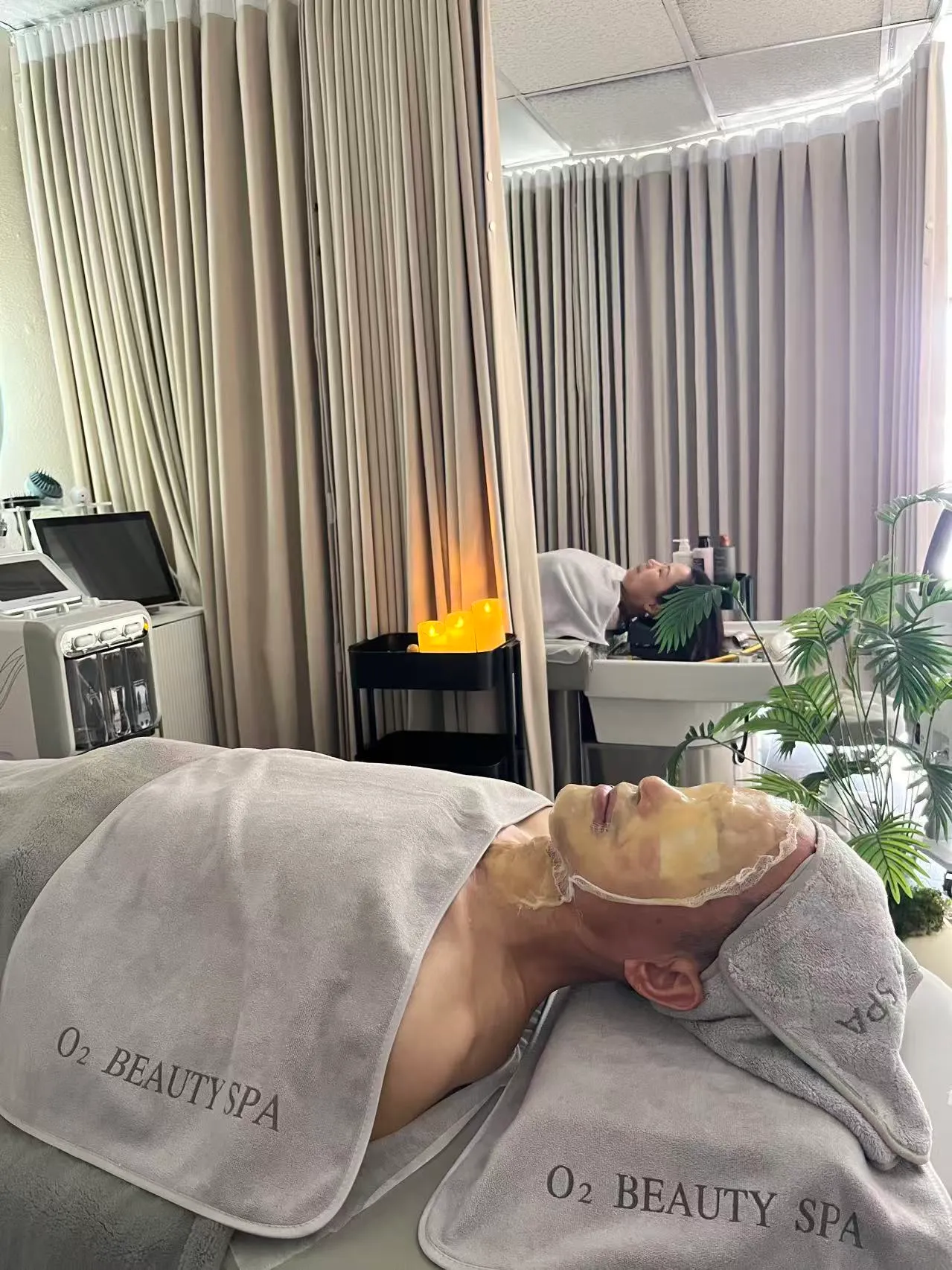
The Jade Gua Sha Facial at O2 Head & Beauty Spa runs 75 minutes and costs $196 at the regular rate or $98 at the member rate; ask the front desk how membership works. The booking page describes it as a facial "featuring jade gua sha and facial sculpting techniques to improve circulation, lift facial contours, and restore a healthy glow." The circulation claim has short-term support from body gua sha on the back, and the contour claim rests on one small trial.
It is the only facial on the facial menu that lists gua sha. The 60 minute Customized Facial has the same base without it, and the 90 minute Luxury Facial adds an aqua peel, LED light therapy and a scalp, neck and shoulder massage instead. When you book, mention anything from the skip list above, such as rosacea, a breakout, blood thinners or a recent injectable, so the person doing your facial knows before the gua sha step begins. The menu lists these steps for the gua sha facial:
- Deep cleansing
- Gentle exfoliation
- Steam therapy
- Facial massage
- One skin solution: Hydrating, Brightening or Anti-Aging
- Jade gua sha and facial sculpting therapy
- Serum infusion and skin barrier repair
- Customized mask
- Hand massage
- SPF protection (daytime)
How do you do facial gua sha at home?
Use light pressure, plenty of slip and one-way strokes from the center of the face outward. The steps below follow Cleveland Clinic's advice and the routine from the 2025 trial, which used 10 minutes a session.
Before the first stroke, run a fingertip along the tool's edge. A chip or crack can scratch the skin, so retire a damaged tool. Patch-test any new oil on your jaw a day ahead if your skin reacts easily, since contact dermatitis is one of the reported risks.
- Start with clean skin and some slip. A facial oil or moisturizer lets the tool glide instead of drag.
- Hold the tool almost flat. Use the long edge rather than the tip, so the pressure spreads out.
- Work from the center outward. Stroke from the chin along the jaw toward the ear, from beside the nose across the cheek, and from the middle of the forehead out to the temple.
- Move in one direction. Lift the tool at the end of each stroke and start again instead of sawing back and forth.
- Keep the pressure light. Faint pinkness is normal, while pain, red speckles or bruising mean you are pressing too hard.
- Stay off the eyelids and any spot that is broken, inflamed or swollen.
- Wash the tool after every use and keep it to yourself. Infection is one of the risks reported in the medical literature, and a shared tool carries someone else's skin and oil.
Questions people ask
What are the benefits of a gua sha facial?
The supported benefits are small and short-term: skin blood flow may rise for a while after a session, puffiness may ease, and in one 2025 trial of 34 women, lower-face contour changed by about 2 mm after 8 weeks of regular self-massage. No controlled study shows that gua sha removes wrinkles or permanently lifts sagging skin.
Is gua sha supposed to leave marks on your face?
No. Body gua sha raises red speckles, called sha, on purpose, but facial gua sha uses very light pressure and should leave faint pinkness at most. Red dots or bruising on the face mean the strokes were too hard.
How often should you do facial gua sha?
No study has set an ideal schedule. The 2025 facial trial used 10 minutes, five days a week, for 8 weeks. If your skin stays calm, a few short sessions a week is a sensible routine; stop if it turns red, sore or starts breaking out.
Is a jade gua sha tool better than other stones?
There is no evidence that it is. The 2025 trial that measured contour changes used a stainless steel and plastic tool, not jade. A smooth edge, a shape that fits your face and a clean surface matter more than the material.
Who should not use gua sha?
Skip it over broken, irritated or sunburned skin and during an acne flare. People with rosacea, eczema or psoriasis, anyone who is pregnant, and anyone taking blood thinners such as aspirin, Coumadin or apixaban should check with a doctor first.
How long is the Jade Gua Sha Facial at O2, and what does it cost?
It runs 75 minutes and costs $196 at the regular rate or $98 at the member rate; ask the front desk how membership works. O2 Head & Beauty Spa is at 1432 S Baldwin Ave, Arcadia, CA 91007, open daily 10 AM to 8 PM. Book online or call (626) 857-6608.
Sources
- Nielsen A et al. — The effect of Gua Sha treatment on the microcirculation of surface tissue (Explore, 2007)
- Braun M et al. — Traditional Chinese gua sha therapy in chronic neck pain: a randomized controlled trial (Pain Medicine, 2011)
- Ahn SH et al. — Facial roller and gua sha massage on facial contour, muscle tone and skin elasticity: an RCT (Journal of Cosmetic Dermatology, 2025)
- Hamp A et al. — Gua-sha, jade roller, and facial massage: are there benefits within dermatology? (Journal of Cosmetic Dermatology, 2023)
- Cleveland Clinic — Gua Sha: What It Is and How To Do It
- American Academy of Dermatology — 7 rosacea skin care tips dermatologists recommend
Written and fact-checked by the O2 Head Spa editorial team against the primary sources above. Menu details and prices are taken from our live booking page.
This guide is for general education only and is not medical advice. Talk with a licensed healthcare provider about what is right for you.
Jade Gua Sha Facial
In Arcadia? Book it at our Baldwin Avenue studio.
O2's Jade Gua Sha Facial takes 75 minutes at 1432 S Baldwin Ave in Arcadia, open daily 10 AM to 8 PM: the full customized facial with jade gua sha and facial sculpting added. If you have rosacea, an acne flare or take blood thinners, mention it when you book, or call (626) 857-6608 first.
O2 Head & Beauty Spa · 1432 S Baldwin Ave, Arcadia, CA 91007 · (626) 857-6608 · Open daily 10 AM – 8 PM.
Keep reading
Tui na, acupressure and meridians
The hand-based side of Chinese bodywork, checked against the same trials.
Read
Tension headache self-care
What may help a tight head, jaw and neck between visits.
Read
Compare O2's four facials
60 to 90 minutes: customized, jade gua sha, luxury and myofascial lifting.
Read